Amazon TACoS With Sponsored Brands and Display Included

TL;DR
TACoS is ad spend divided by all sales, and most calculators leave Sponsored Brands and Display out. A worked example from a demo store, read in Claude.
✨ AI-assisted research, automated editorial review by Avanta Global EOOD. Learn more
TACoS (total advertising cost of sales) is your ad spend divided by all your sales, not only the sales Amazon attributes to ads. ACoS asks whether an ad paid for itself; TACoS asks how much of the whole business runs on advertising. A falling TACoS while sales grow usually means organic sales are carrying more of the load.
The calculation is one division. Getting the two numbers right is the hard part, and the most common mistake is on the top line: the ad spend. Sellers who run Sponsored Brands or Sponsored Display often compute TACoS from the Sponsored Products report alone, because it is the one they open, and understate their real ad bill.
This post works one example through, asked in Claude connected read-only to AgentXray's public demo store. Every number below is from that demo store, a synthetic US seller, on 23 October 2026. None of it is a real account.
The worked example
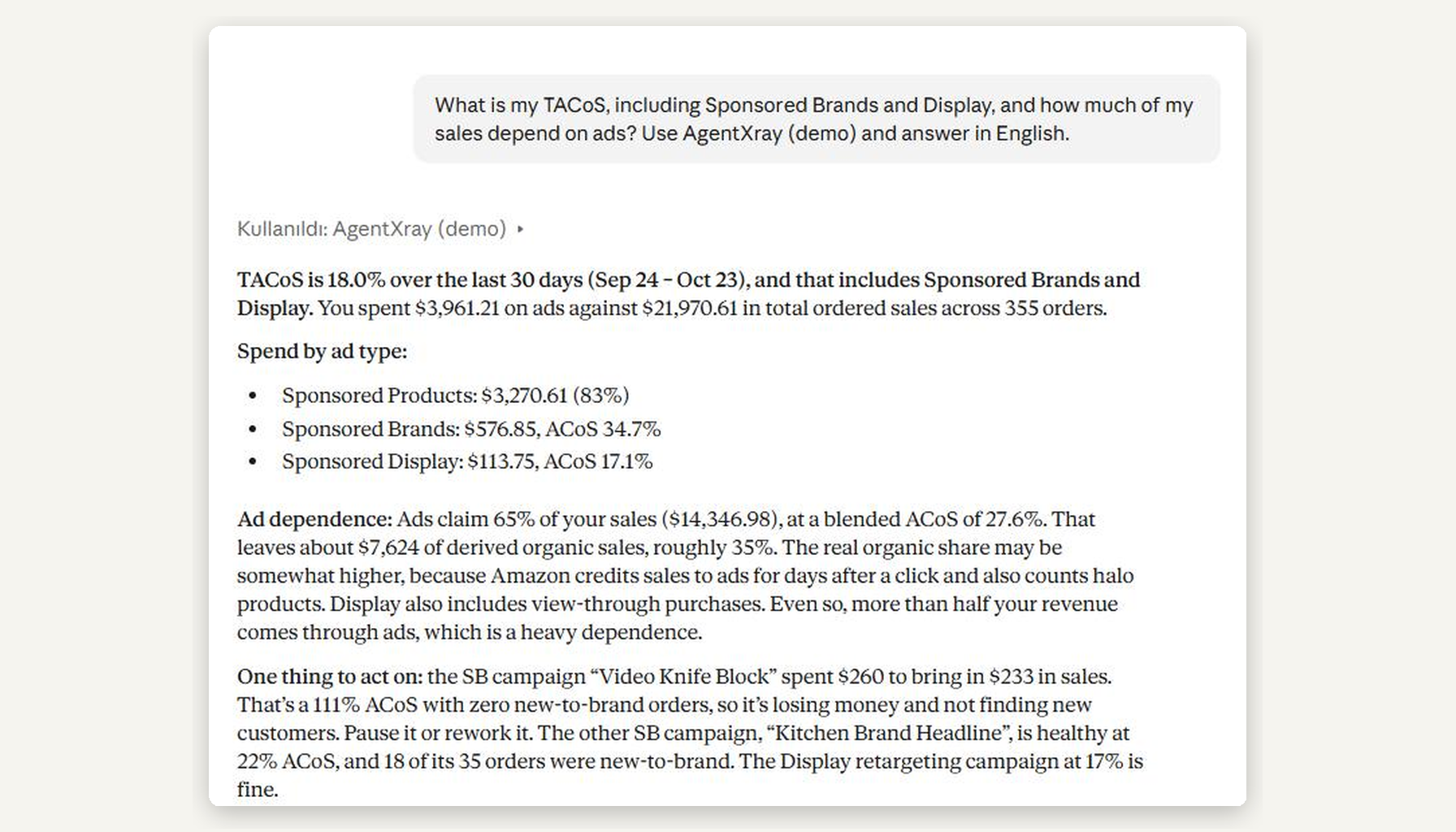
What is my TACoS, including Sponsored Brands and Display, and how much of my sales depend on ads?
Over the last 30 days the demo store spent $3,961.21 on ads against $21,970.61 of ordered sales across 355 orders:
| Sponsored Products spend | $3,270.61 (83% of the ad bill) |
| Sponsored Brands spend | $576.85 |
| Sponsored Display spend | $113.75 |
| Total ad spend | $3,961.21 |
| All ordered sales | $21,970.61 |
| TACoS | 18.0% |
Sponsored Brands and Display are 17% of this store's ad bill. Leave them out and the same store would report a TACoS that looks healthier than it is.
How much of the business depends on ads
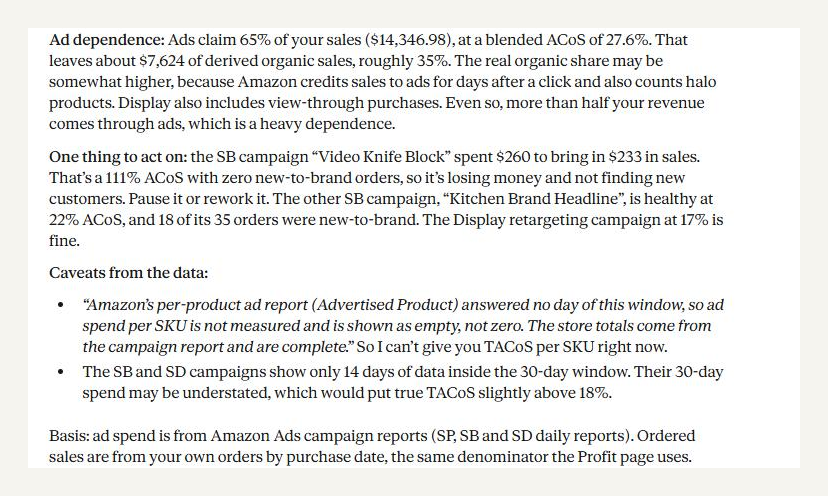
Ads claim 65% of the demo store's sales ($14,346.98), at a blended ACoS of 27.6%. The rest, about $7,624 or roughly 35%, is derived organic sales: total sales minus ad-attributed sales.
Claude was careful with that word, and so should you be. The real organic share is probably somewhat higher, because Amazon credits sales to an ad for days after a click, counts other products of yours bought after the click, and, for Display, counts some purchases by shoppers who saw an ad without clicking. Even so, more than half this store's revenue comes through ads, which is a heavy dependence.
One thing to act on
TACoS is a business-level number, but the answer did not stop there. One Sponsored Brands campaign spent $260 to bring in $233 in sales, a 111% ACoS, with zero new-to-brand orders. Claude's advice: pause it or rework it. The other Sponsored Brands campaign was healthy at 22% ACoS, and 18 of its 35 orders were new-to-brand.
What the numbers could not tell
Two caveats came back with the answer, and both matter for anyone doing this by hand:
- TACoS per SKU needs a per-product ad report. Amazon's Advertised Product report answered no day of this window, so ad spend per SKU was not measured, and the tool showed it as empty rather than zero. The store totals come from the campaign reports and are complete. A per-SKU TACoS of 0% because a report is missing is the kind of number that ends up in a spreadsheet and gets believed.
- Check that every ad type covers the same window. The demo's Sponsored Brands and Display data covered 14 of the 30 days, so true TACoS could be slightly above 18%.
The formula, for reference
TACoS = (Sponsored Products + Sponsored Brands + Sponsored Display spend) ÷ all ordered sales, over the same days.
Use ordered sales by purchase date for the denominator, and the same date range for all three ad reports. In AgentXray, the denominator is the same ordered-sales figure the Profit page uses.
Asking it on your own store
The tool behind this answer is get_tacos, with get_sponsored_brands and get_sponsored_display for the per-campaign detail. All are listed with sample answers in the MCP tool reference.
- Connect Claude or connect ChatGPT to your Amazon Ads and Seller Central accounts.
- Or try it on the read-only demo store first: the consent screen offers "connect the demo store instead".
- More on reading Sponsored Brands: new-to-brand orders, read by your AI.
FAQ
What is a good TACoS on Amazon?
There is no universal number. TACoS depends on margin, category and how established the product is. What matters more is the direction: a TACoS that falls while total sales hold or grow means organic sales are taking over.
What is the difference between ACoS and TACoS?
ACoS divides ad spend by ad-attributed sales and asks whether an ad paid for itself. TACoS divides ad spend by all sales and asks how much of the business depends on advertising.
Should Sponsored Brands and Display be included in TACoS?
Yes. TACoS is meant to capture the whole ad bill. Leaving out Sponsored Brands and Display understates it for any store that runs them.
Why is my organic sales figure only an estimate?
Because it is derived: total sales minus the sales Amazon attributes to ads. Amazon's attribution includes purchases days after a click, purchases of other products from the same brand, and, for Display, some view-through purchases, so ad-attributed sales can include sales that would have happened anyway.
About this article
This article was researched and drafted with AI assistance. Before publication, it passed automated editorial review against Avanta Global EOOD's published editorial standards (factual accuracy, source attribution, voice & readability). Our editorial standards page documents exactly what we check. We continuously monitor published content for accuracy and update articles when new information emerges. Learn more about our editorial process and the team behind AgentXray.